Journalists are given a tour of the Metaverse Bridge Sim

Defence journalists discover the synthetic training reshaping naval readiness, at Metaverse VR.

14 July 2026

Metaverse VR and Capita Selborne welcomed defence journalists to Portsdown Technology Park for an exclusive inside look and handson demonstration of Metaverse VR’s virtual bridge simulators, synthetic training systems and wider defence training technology underpinning Royal Navy training modernisation.

The visit provided a detailed view of how simulation, synthetic environments and rapid capability development are reshaping naval readiness. 

Beginning with an introduction from Toby Everitt, CEO and founder of Metaverse VR, and Ade Morley, Managing Director at Capita Selborne, the journalists were given a walkthrough of how synthetic training, spiral development and rapid procurement have enabled the Royal Navy to modernise bridge and navigation training at unprecedented speed.

Inside the Royal Navy’s Synthetic Training Ecosystem

Journalists took to the seas, with Metaverse showcasing its full virtual bridge, control room and engine room simulators, as well as UAS and Counter‑UAS training systems. These capabilities allow training to be delivered early, then iteratively improved through life, supporting the Navy’s shift toward more agile, data‑driven and synthetic training environments

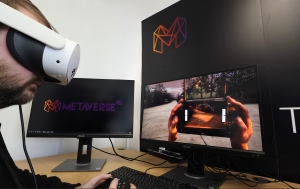
Journalists stepped inside the simulators, observed live demonstrations and spoke directly with the teams responsible for delivering and supporting the systems. 

Joanna Bailey, editor of ADS Advance, said the experience helped contextualise the scale and realism of today’s naval training technology. 

“I’m quite new to maritime defence, being an aviation girl myself, so I treated this very much as a learning opportunity and I learnt an awful lot.  

“Our hosts were incredibly knowledgeable and answered all our questions brilliantly.  

“And the hands-on demos, being able to actually see the technology in action, really does bring it to life for us in a way you simply don’t get from reading about it.” 

Synthetic training as a core component of naval readiness

Throughout the day, Metaverse VR and Capita highlighted how synthetic training is becoming central to Royal Navy training and operational preparation.

The Warfighter Readiness paper calls for greater use of simulation, faster lesson integration from the frontline and more agile training delivery. These themes were reflected across the briefings and demonstrations. 

Bailey noted the broader relevance across defence domains: 

“Simulations are definitely the way forward, not just for naval operations but for aerospace and the drone economy as well.  

“You can’t take huge pieces of equipment offline to let trainees experiment on them, so having them practise in a simulated environment makes far more sense. 

“It means they’re ready to go to work the moment they step onto the real thing.” 

SME innovation and the importance of support structures

The visit also touched on the pressures facing defence SMEs, particularly during periods of uncertainty around DIP and SDR timelines. Bailey reflected on the impact: 

“We’ve seen a lot of good companies that aren’t there anymore because of delays, because of the way funding’s structured, and because of how difficult it is for SMEs to work with the MOD.  

Journalist inside a Metaverse VR simulator, asking questions and learning more about how it works.

“Metaverse VR has clearly been well supported by Capita, and that bridging role between an innovator and the Ministry of Defence is incredibly important.” 

Despite the challenges, she was clear about the strength of the UK’s innovation base: 

“Frankly, the UK’s got bags of innovation. We’ve got great companies and great people, and we just need a bit more certainty and a bit more willingness to fund it properly.  

“If SMEs can get the backing they need, they’ll continue delivering world class capability.” 

A clearer understanding of synthetic training’s value 

Before the visit, Bailey admitted she wasn’t sure what to expect but ultimately found it invaluable in opening her eyes to the benefits of synthetic training. 

“Now I’ve come for the day, I’ll be telling all my colleagues. It’s been genuinely eye opening.” 

And it was this outcome Everitt and Morley were hoping for. Speaking after the visit, Everitt said the value of bringing journalists into the environment is that it shows, rather than tells, what modern synthetic training can achieve.

Joanna Bailey, Editor of ADS Advance, tries out a VR headset inside Metaverse VR's bridge simulator

“When people step inside these simulators and see how the systems work together, the conversation changes.  

“You can talk about synthetic training, spiral development and rapid delivery, but nothing lands quite like seeing it in action.  

“What we want is for people to understand how these capabilities support the Royal Navy today and how they will evolve through life. 

“Days like this help build that understanding and show the importance of the Selborne ecosystem in enabling SMEs like ours to deliver at speed.” 

Interested to find out more?

Our team are ready to answer all of your questions.
Get in touch today!

Metaverse VR

Are your teams truly prepared for evolving risks?

Find out the gaps in the training programmes in less than 60 seconds. Answer 8 quick questions and get a personalised report in your inbox.

Metaverse VR

Be the first to know

Get our newsletter. Read the most up-to-date training news, technology innovations, and promotions in your inbox.