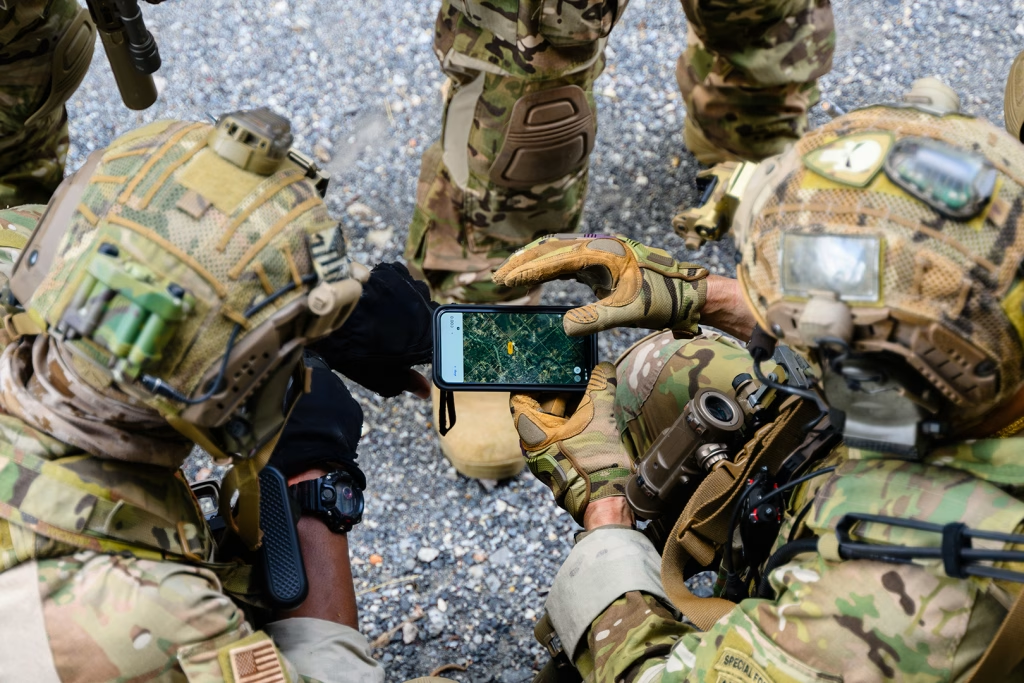


In this article, we look at five ways mixed reality training (MR) improves military skill retention by enabling immersive repetition, realistic mission rehearsal, collaborative team training, scalable access to training environments and data-driven performance feedback.
Quick Jump
In June 2026, all of the UK’s five Astute class submarines were withdrawn from active duty to await routine maintenance, leaving Britain without an active attack-submarine force.
As a result, all five crews were grounded.
Aside from the obvious defence vulnerability, Cdr Ryan Ramsey, a former nuclear submarine captain, highlighted a broader issue not getting enough attention, saying “You could lose vital skill sets if you’re not operating at sea.”
Without an operational vessel, crews were left without an active environment to maintain basic judgement skills, procedural fluency or continue regular mission rehearsal and simulation-based training.
Like all high-performance professions, submarine operations are unforgiving. Skills fade quickly when they are not rehearsed in context, and traditional training tools cannot replicate the pressure, tempo or complexity of real missions.
This is exactly the type of challenge mixed reality is built to solve.
When platforms are offline, unavailable or in short supply, MR gives crews a way to stay sharp, practise realistically and retain the skills that matter most.
Inside high-fidelity mixed-reality environments, the brain encodes every second as a lived event rather than abstract information.
This matters because activities that feel experienced are stored more deeply and recalled more reliably under pressure.
Cognitive science shows immersive, context‑rich environments activate the same memory systems used in real operations, which strengthens retention far more effectively than classroom or 2D training.
Repetition then reinforces these pathways. When operators can rehearse the same task repeatedly in a realistic environment, they build familiarity, reduce cognitive load and retain procedural fluency for longer.
This is especially important in domains where skills degrade quickly without practice, such as submarine operations, aviation and UAS control.
Mixed reality training blends physical and digital environments to deliver immersive, interactive scenarios that replicate real-world operational conditions, creating highly effective simulation training experiences.
Everything teams will or could experience for real, they can train for repeatedly, authentically and safely. Failures do not cost or risk anything. Instead, each failure becomes the next learning experience until there is just mastery.
This works because the brain retrieves information more effectively when the training environment shares cues with the operational environment.
Skills learned in realistic scenarios are recalled faster and applied more accurately under pressure, which is why scenario-based training consistently outperforms classroom or decontextualised practice.
MR strengthens this effect by placing crews inside operator-truthful synthetic training environments that mirror real interfaces, real procedures and real mission conditions. They rehearse the same tasks, follow the same workflows and experience the same pressures they will face during live missions.
This creates a direct bridge between training and operations, increasing the likelihood that skills learned in simulation will transfer cleanly into real-world performance.
Mixed reality isn’t designed to replace traditional training, but rather to act as a modern, scalable capability that enriches overall training ecosystems.
Where live training is expensive, MR is cost efficient. Where live scenarios are inherently risky, MR provides a safe alternative.
And where live assets are limited, offline or committed elsewhere, MR enables access to high-value training that would otherwise be unavailable to help organisations maintain operational readiness even when physical platforms are not accessible.
This aligns closely with Live, Virtual, Constructive (LVC) training architectures used across defence, where live participants, virtual environments and simulated entities are integrated to create flexible, scalable and interoperable training systems.
In this context, mixed reality becomes a practical enabler of LVC approaches, increasing the fidelity of virtual scenarios while extending the availability and utility of live training.
As a result, MR strengthens existing training protocols by ensuring operators arrive better prepared, more fluent and more confident, even when traditional methods cannot deliver the required frequency, scale or realism.

Whole environments can be constructed to faithfully recreate authentic bridge layouts, cockpit design or control room configurations, allowing full crews to train together inside the same shared scenario.
Mixed reality training is perfectly adapted to multi-user training.
Whole environments can be constructed to faithfully recreate authentic bridge layouts, cockpit design or control room configurations, allowing full crews to train together inside the same shared scenario.
This also enables distributed training, supporting continuous operational readiness across geographically dispersed teams.
It’s a feature many teams now use to work specifically on coordination, communication and collective decision making.
MR removes the constraints that often limit team‑level training. Crews can enter the same environment, see the same information and respond to the same pressures in real time, even when live platforms are unavailable or committed elsewhere.
They can rehearse communication discipline, refine handovers and build the shared situational awareness that underpins effective operations.
Because scenarios are repeatable, teams can run complex drills again and again until coordination becomes instinctive.

Mixed reality training generates detailed performance data that traditional methods cannot capture.
Every action, decision and interaction can be recorded, analysed and reviewed, giving instructors and teams a level of insight that is impossible to achieve through live exercises alone.
MR systems can track timing, accuracy, compliance with procedures, communication patterns and training effectiveness metrics.
This creates a clear picture of how individuals and teams perform under pressure, where errors occur and how skills develop over time.
It also allows instructors to deliver targeted feedback immediately, which is proven to accelerate learning and improve long‑term performance.
Because scenarios are repeatable, teams can run the same drill again with the benefit of precise, data‑driven feedback.
This turns training into a continuous improvement loop, strengthening readiness and ensuring that crews progress with clarity and confidence.

Mixed reality accelerates the journey from basic competence to instinctive, second‑nature performance.
By combining immersion, realism, scalability, team‑level training and data‑driven feedback, it gives crews more opportunities to practise, refine and repeat the skills that matter.
The result is a defence training technology environment where operators learn faster, retain more and arrive better prepared for real‑world operations.
This is particularly valuable across defence, aerospace, aviation and maritime operations where readiness depends on maintaining complex skills over time.
Platforms such as VirtualSky enable this through immersive mixed reality training environments designed for defence and high-performance operations.
Each can be used in training, depending on what you’re preparing for.
Yes. Multi-agent training is a core strength of immersive tech. We can build complex, branching scenarios with full team interaction, which is great for simulating mission coordination, communication under stress and tactical awareness.
Mixed Reality brings together multiple perspectives, such as police, fire and paramedics into one live scenario. Teams can rehearse coordinated response to complex incidents in a shared, dynamic environment.
Yes. Our training experiences are built for distributed teams. We can deploy modules across locations and even continents to deliver a shared training experience in real time, wherever your people are
Yes. We align scenario development with your formal training goals and standards to help you evidence skill proficiency, consistency and operational readiness.
Our team are ready to create your perfect training environment.
Get in touch today!

Find out the gaps in the training programmes in less than 60 seconds. Answer 8 quick questions and get a personalised report in your inbox.
Get our newsletter. Read the most up-to-date training news, technology innovations, and promotions in your inbox.