03 June 2026
Quick Jump
Mission rehearsal has always relied on simulation and synthetic training, but it has also been restricted by long-standing challenges of fixed facilities, single user systems and scenarios difficult to adapt or repeat.
For joint readiness, constraints like these limits how easily teams can train together, share a common operating environment or rehearse multi‑domain tasks in one coherent space.
Virtual reality changes that. Today, defence teams are integrating VR into existing training protocols and systems as part of the wider shift towards digitally enabled, synthetic training.
It delivers a fully immersive, cohesive and multi‑user layer that removes legacy barriers and strengthens the mission rehearsal pipeline.
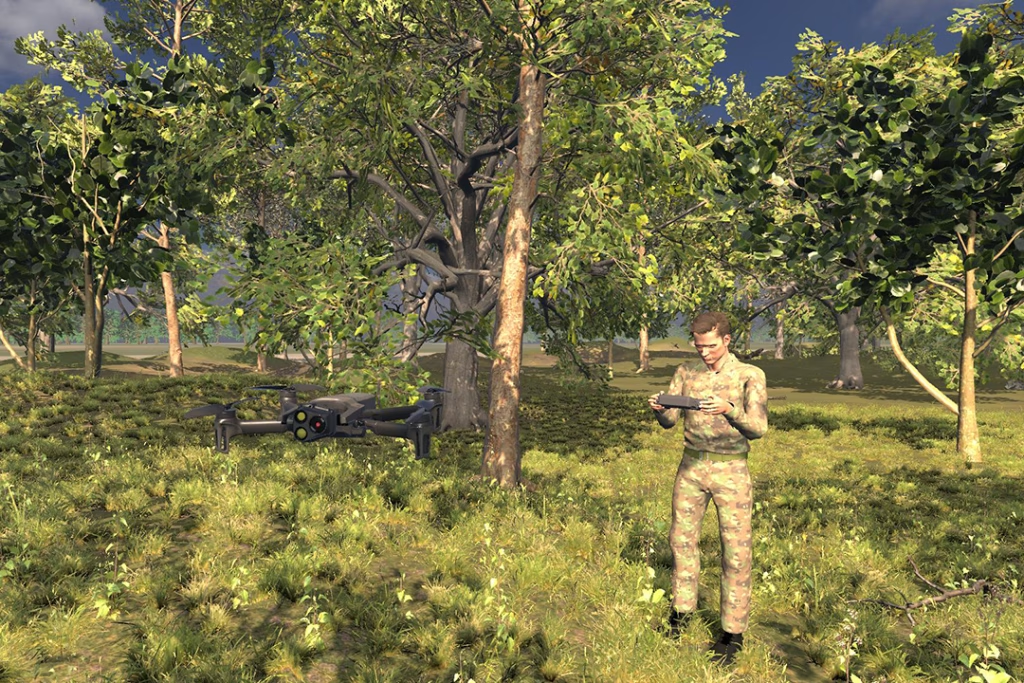
Immersive training systems, like virtual or mixed reality, are being used by armed forces instructors to create tailored environments to match precise training needs.
Multi-agency teams are dropped into digital twin replicas of towns, cities and operational terrain built to reflect real mission locations in which threat profiles, weather, visibility and comms conditions can be adjusted instantly.
Because everything is synthetic, instructors can pause, reset or modify scenarios on demand.
By offering this level of control, mission rehearsal training can be made more consistent across teams, more adaptable to emerging requirements and far easier to refine through repetition.
A headset, a controller and a terminal. With these items, teams plug into a shared training environment from wherever they are. There is no need for major system changes, nor requirement for large‑scale infrastructure investment.
The advantage is in the simplicity. Army, Navy and Air Force personnel enter the same immersive, multi‑domain synthetic environment and prepare together for high‑risk scenarios, even when they’re geographically dispersed.
VR removes the dependency on fixed facilities and single‑user systems, making joint mission rehearsal far more accessible.
Integrating synthetic simulation systems in this way delivers a shared operational picture in which airspace deconfliction, ground manoeuvre, maritime interdiction and ISR feeds can all be rehearsed together in real time.
Modern operations span land, sea, air, cyber and space, often involving multinational forces and advanced capabilities. Recreating this complexity through live training alone is extremely challenging and often prohibitively expensive. Synthetic training that exposes individuals and teams to this type of pressure is vital.”
Air Vice‑Marshal (Ret’d) Gary Waterfall CBE,
Calibre News
When integrated within traditional training ecosystems, VR solutions, like Metaverse VR’s VirtualSky, reduce much of the time, costs and coordination normally required to run live mission rehearsal.
Scenarios can be loaded, modified and reset in minutes, without the logistics burden of booking large simulators, coordinating physical assets or moving teams between facilities.
This lowers the overhead for instructors and allows more training value to be delivered within the same window.
Instead of spending hours preparing to train, units run multiple iterations, test variations and rehearse emerging mission profiles at short notice. It’s a practical way to increase training tempo without increasing infrastructure demands.
A mission, task or procedural failure in a VR training environment is never costly. Nor is it ever a threat to life or assets.
Instead, every mistake is an opportunity to learn, repeat and refine mission‑critical skills.
Within these controlled synthetic environments, high‑risk tasks normally difficult, dangerous or expensive to recreate can be rehearsed safely.
And because scenarios can be reset instantly, teams can run multiple iterations with consistent variables, building shared mental models and improving collective performance.
This structured repetition accelerates learning and strengthens joint readiness without exposing personnel or equipment to unnecessary risk.
Immersive technologies such as virtual, augmented and mixed reality will not replace live simulation, but their integration already offers clear advantages for UK and global defence teams.
Unlocking their benefits starts with understanding where it strengthens your current training ecosystem whether that’s scenario control, distributed access, multi‑user coordination or safe repetition of high‑risk tasks.
From there, custom environments can be built to reflect real mission locations, operational constraints and joint training requirements.
Our extended reality team works with defence organisations to design and deliver these environments.
From multi‑user scenarios to full mission walk‑throughs, we help teams introduce VR to complement existing training, support instructors and enhance readiness across the force.
Our team are ready to answer all of your questions.
Get in touch today!
Find out the gaps in the training programmes in less than 60 seconds. Answer 8 quick questions and get a personalised report in your inbox.
Get our newsletter. Read the most up-to-date training news, technology innovations, and promotions in your inbox.